CISO AI Security Governance Checklist: What to Require Before Any GenAI Goes Live
- Bob Rapp

- 6 days ago
- 5 min read
As a CISO, you're facing an unprecedented challenge: securing AI systems that can think, create, and act autonomously within your enterprise. Unlike traditional software with predictable behaviors, GenAI introduces dynamic risks that evolve with every interaction. The question isn't whether to deploy GenAI: it's how to do it without expanding your attack surface into uncharted territory.
This comprehensive checklist provides the security controls you need before any GenAI system goes live in your environment. Based on emerging frameworks from NIST, ISO 27001 principles, and EU AI Act security requirements, these controls ensure you're not just checking compliance boxes: you're building defensible AI governance.
Pre-Deployment Risk Assessment & Classification
System Risk Categorization □ Classify the GenAI use case by risk level (low/medium/high/critical) based on data sensitivity, decision impact, and potential for harm □ Document the AI system's purpose, scope, and intended business outcomes □ Identify all data types the system will process, including PII, financial records, and proprietary information □ Assess potential impact on customers, employees, and business operations if the system fails or is compromised □ Map the system to existing enterprise risk tolerance levels and compliance requirements
Executive Accountability Framework □ Assign an executive sponsor accountable for AI governance outcomes □ Define clear ownership across roles: CTO for technical safeguards, CISO for security, Legal/Compliance for regulatory alignment □ Establish decision-making authority for system approval, modification, or termination □ Create escalation procedures for security incidents involving AI systems

Security Architecture & Threat Modeling
Comprehensive Threat Analysis □ Conduct threat modeling specifically for prompt injection attacks and prompt manipulation □ Analyze risks for model inversion attacks that could expose training data □ Assess data leakage potential through model outputs and inference patterns □ Evaluate goal hijacking scenarios where attackers redirect AI behavior □ Document agent behavior validation requirements beyond simple output filtering
Technical Security Controls □ Implement API access controls with rate limiting and authentication requirements □ Deploy input sanitization and validation for all user prompts and data inputs □ Establish runtime guardrails that inspect intent and block unsafe behavior before execution □ Configure real-time policy enforcement on every attempted action □ Set up model output filtering and content inspection protocols
Red Team Testing Requirements □ Schedule regular red team exercises targeting AI-specific attack vectors □ Test prompt injection resistance across different user personas and access levels □ Validate that security controls remain effective as the model learns and adapts □ Document findings and remediation timelines for identified vulnerabilities
Access Management & Identity Controls
Permission Mapping & Least Privilege □ Explicitly define what the GenAI system may access within your infrastructure □ Map identity inheritance paths and service account permissions □ Implement least-privilege principles for AI system permissions □ Prevent privilege escalation by tracing all actions to human creators and owners □ Monitor permission changes and access pattern anomalies continuously
Integration Surface Monitoring □ Document all execution paths, tool access, and API connections □ Map cross-system dependencies and data flow boundaries □ Monitor new integration points as the system evolves □ Establish controls for third-party integrations and external API calls □ Implement network segmentation to limit AI system network access

Vendor Management & Supply Chain Security
Third-Party AI Vendor Assessment □ Evaluate vendor data handling practices and transparency commitments □ Verify vendor compliance with SOC 2, ISO 27001, and relevant security frameworks □ Confirm whether shared data may be retained, repurposed, or used for model training □ Review vendor incident response capabilities and notification procedures □ Establish contractual security requirements and audit rights
Model Supply Chain Validation □ Document the provenance of AI models, including training data sources □ Verify model integrity through checksums and digital signatures □ Assess security of the model development and deployment pipeline □ Review version control and rollback capabilities for AI models □ Implement dependency scanning for AI frameworks and libraries
Monitoring & Incident Response
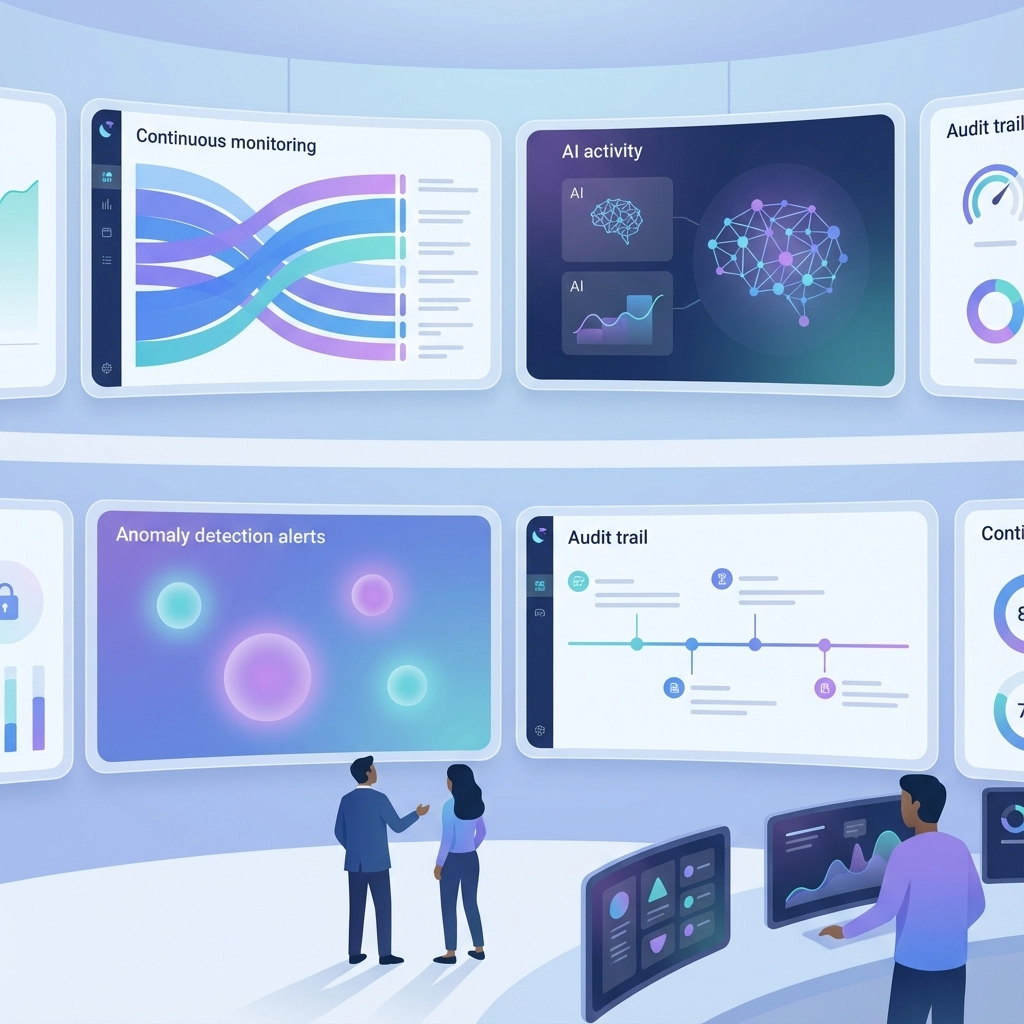
Continuous Security Monitoring □ Deploy automated monitoring for abuse patterns and anomalous usage □ Implement bot detection and proliferation monitoring □ Set up alerts for unusual data access patterns or privilege escalation attempts □ Monitor for prompt injection attempts and successful bypasses □ Track model behavior drift and unexpected output patterns
Audit & Traceability Requirements □ Ensure complete audit trails for all AI-initiated actions and decisions □ Implement centralized logging for AI system interactions □ Establish data retention policies for AI audit logs □ Create tamper-evident log storage with appropriate access controls □ Enable correlation between user inputs, AI processing, and system outputs
Incident Response Procedures □ Develop AI-specific incident response playbooks □ Define containment procedures for compromised AI systems □ Establish communication protocols for AI-related security incidents □ Create rollback procedures for AI systems exhibiting harmful behavior □ Document post-incident review processes including model retraining considerations
Compliance & Documentation Framework
Policy Documentation □ Create centrally accessible AI security policies across all departments □ Develop actionable usage guidelines outlining approved tools and use cases □ Document prohibited activities and data types for AI processing □ Establish model validation and bias testing requirements □ Define fairness evaluation criteria before system deployment
Regulatory Alignment □ Map AI system controls to NIST AI Risk Management Framework requirements □ Verify alignment with ISO 27001 information security principles □ Assess EU AI Act compliance requirements for your system's risk classification □ Document privacy impact assessments for AI data processing □ Establish data subject rights procedures for AI-processed information
Change Management □ Implement formal change control for AI model updates and retraining □ Require security review for significant system modifications □ Document rollback procedures and version control for AI configurations □ Establish testing requirements before deploying model updates to production
Making It Operational
The difference between effective AI governance and security theater lies in execution. These controls must be operational, not aspirational. Each checklist item should have:
Clear ownership with named individuals responsible for implementation and ongoing management
Measurable criteria for success that can be audited and validated
Integration points with existing security tools and processes
Regular review cycles to adapt as AI systems and threat landscapes evolve
Your GenAI systems will only be as secure as your governance framework allows. By implementing these controls before deployment, you're not just protecting your organization: you're building the foundation for responsible AI adoption that scales with your business needs.
Ready to implement comprehensive AI governance? Start with a demo to see how these controls integrate into your existing security infrastructure.
This post was created by Bob Rapp, Founder aigovops foundation 2025 all rights reserved. Join our email list at https://www.aigovopsfoundation.org/ and help build a global community doing good for humans with ai - and making the world a better place to ship production ai solutions
Comments