The Board Member's Quick-Start Guide to AI Oversight: Do This First
- Bob Rapp

- 2 days ago
- 5 min read
When 73% of board members admit they lack sufficient knowledge to oversee AI initiatives effectively, the urgency for structured governance becomes clear. Yet waiting for perfect AI literacy isn't an option: regulatory pressure is mounting, competitive risks are escalating, and stakeholders expect accountability now.
The solution isn't to master every technical detail. Instead, successful board oversight starts with establishing the right governance foundation and asking the right questions. Here's your practical roadmap for immediate action.
Establish Clear Governance Accountability
Your first move determines everything else: define who owns AI oversight at the board level. This isn't about technical expertise: it's about accountability structure.
For organizations with extensive AI applications, consider forming a dedicated AI committee with 3-4 members who can develop deeper domain knowledge. For companies with limited AI use, integrate oversight within existing risk, audit, or technology committees. The key is explicit assignment: no shared responsibility that leads to no responsibility.
Document this structure formally. Board minutes should reflect which committee has primary AI oversight, what their mandate includes, and how they'll report to the full board. This clarity prevents the common scenario where AI risks fall through governance cracks because "everyone thought someone else was watching."

Align on Strategic AI Direction
Before diving into risk frameworks, establish fundamental strategic alignment with management. Your board needs clear answers to four critical questions:
Strategic Posture: Is your organization an AI leader pushing boundaries, a fast follower adapting proven approaches, or a cautious observer waiting for regulatory clarity? Each posture requires different oversight intensity and risk appetite.
Investment Framework: What's the 3-5 year AI agenda, and how will it be funded? Understanding whether you're making $100K experimental investments or $10M+ transformational bets shapes your governance priorities.
Value Creation Path: How will AI initiatives drive business results? Boards need metrics that connect AI investments to revenue growth, cost reduction, or competitive advantage: not just technical performance indicators.
Boundaries and Guardrails: Where won't your organization deploy AI? These boundaries define your ethical stance and help management make consistent decisions without constant board consultation.
Document these strategic decisions and revisit them quarterly. AI landscapes shift rapidly, and strategic alignment prevents costly course corrections later.
Create Regular Information Flows
Effective AI oversight requires structured, ongoing information flow: not just crisis-driven updates. Establish a normalized reporting cadence that treats AI as a routine governance topic, not an occasional special presentation.
Schedule quarterly presentations from your Chief Technology Officer, Chief Risk Officer, and General Counsel covering AI developments in their domains. This multi-perspective approach ensures you're seeing technical progress, risk evolution, and regulatory changes through different lenses.
Between formal reports, establish monthly AI updates in board materials covering three key areas: new AI deployments or pilots, emerging regulatory developments affecting your sector, and any incidents or performance issues requiring board awareness.
Consider rotating external experts through board meetings: AI ethicists, industry analysts, or regulatory specialists who can provide sector-specific insights your internal team might miss.
Build Essential Board AI Knowledge
While you don't need technical expertise, certain foundational knowledge is non-negotiable for effective oversight. Focus on three areas:
AI Application Categories: Understand the difference between generative AI (creating content), predictive AI (forecasting outcomes), and automated decision-making systems. Each carries different risk profiles and regulatory implications.
High-Risk Use Cases: Learn to identify AI applications that pose significant regulatory, reputational, or operational risks: typically those affecting employment decisions, financial services, healthcare, or customer-facing automated decisions.
Governance Standards: Familiarize yourself with key frameworks like the NIST AI Risk Management Framework, EU AI Act requirements, and industry-specific guidance relevant to your sector.
One-Page Board AI Oversight Checklist
Governance Structure
AI oversight responsibility explicitly assigned to board committee
Committee charter updated to include AI governance mandate
Regular reporting schedule established (minimum quarterly)
External AI expertise accessible to board (advisors, consultants)
Strategic Alignment
Board-approved AI strategy document in place
AI investment framework and budget approved
Risk appetite for AI applications clearly defined
Ethical boundaries and prohibited uses documented
Risk Management
AI risk assessment process established
High-risk AI applications identified and tracked
Incident response plan includes AI-specific scenarios
Regular third-party AI risk assessments conducted
Regulatory Compliance
Current regulatory requirements mapped and monitored
Legal review process for new AI applications implemented
Data governance policies updated for AI use cases
Regular compliance reporting to board established
Performance Monitoring
AI performance metrics defined and tracked
Regular AI system audits scheduled
Bias and fairness monitoring implemented
Customer and stakeholder feedback mechanisms active
Sample Quarterly Dashboard Elements
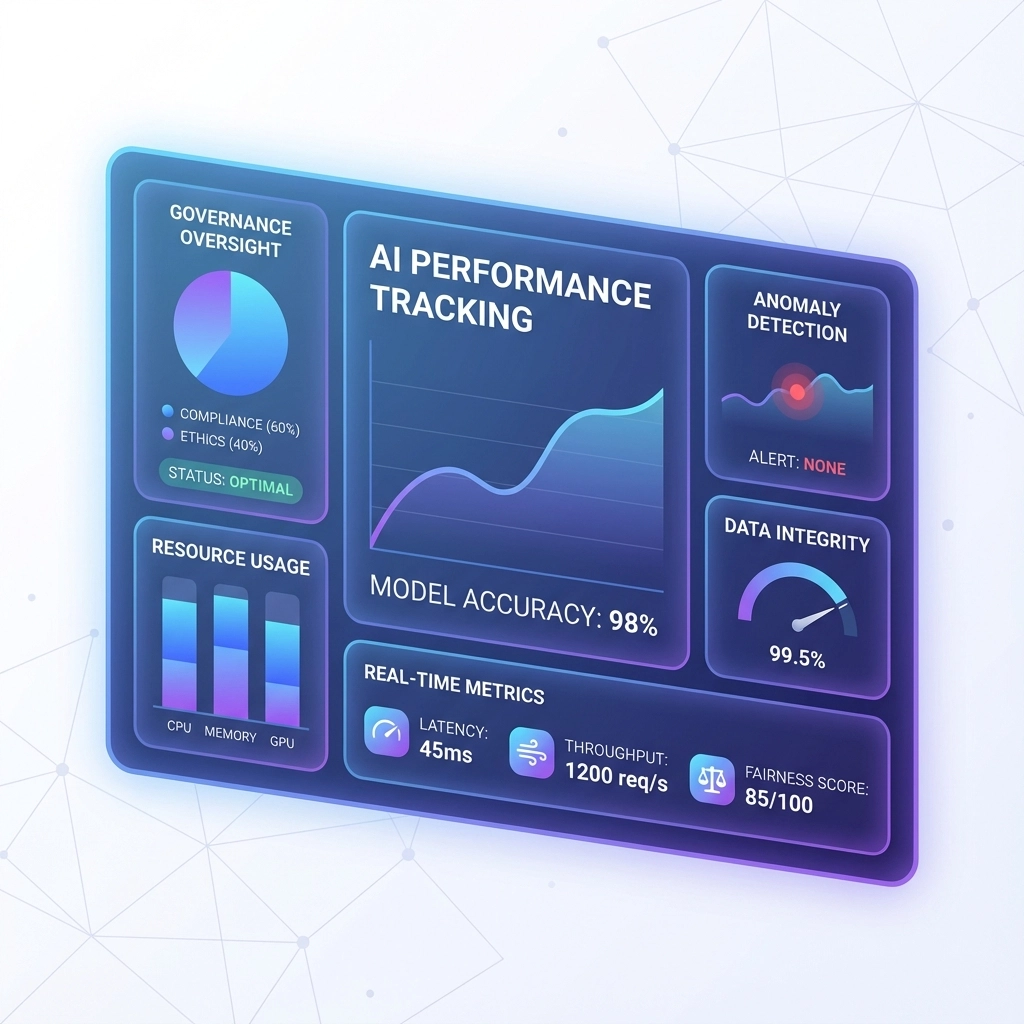
Your quarterly AI oversight dashboard should provide actionable insights without overwhelming technical detail. Here are essential components:
Strategic Progress Tracking
AI initiatives launched this quarter vs. planned
Budget allocation: approved vs. actual AI spending
ROI metrics for mature AI applications
Competitive positioning updates
Risk and Compliance Status
Number of high-risk AI applications currently deployed
Open regulatory compliance items and resolution timelines
AI-related incidents or near-misses this quarter
Third-party risk assessment findings summary
Operational Performance
System uptime and availability metrics for critical AI applications
Model performance degradation alerts and responses
User satisfaction scores for customer-facing AI tools
Data quality metrics affecting AI system performance
Future Outlook
New regulatory requirements coming into effect next quarter
Planned AI application rollouts and associated risks
Technology trend impacts on current AI strategy
Resource requirements for upcoming initiatives
Implement Continuous Oversight Mechanisms
Static governance fails in dynamic AI environments. Establish continuous monitoring processes that keep pace with rapid AI evolution.
Create automated alerting systems for AI performance degradation, unusual system behavior, or regulatory requirement changes. Your oversight shouldn't depend on management remembering to escalate issues.
Schedule regular AI system audits by independent third parties who can assess both technical performance and governance compliance. These audits should examine bias, fairness, accuracy, and alignment with organizational values.
Establish stakeholder feedback channels specifically for AI-related concerns. This includes employee reporting mechanisms, customer complaint tracking, and external stakeholder engagement processes.
Move Beyond Compliance to Strategic Value
Effective AI oversight transcends regulatory compliance to drive strategic value creation. Your board should regularly assess whether AI investments are delivering promised business outcomes and whether governance processes are enabling or constraining innovation.
Ask management to demonstrate how AI governance decisions have prevented problems, improved outcomes, or created competitive advantages. Governance that only identifies risks without enabling opportunities will struggle to maintain organizational support.
Consider AI oversight as part of your broader digital transformation governance. Companies that treat AI as an isolated technical issue miss opportunities to leverage AI governance insights for broader technology and data strategy improvements.
The board members who master AI oversight now will be the ones positioned to guide their organizations through the AI transformation successfully. Start with these foundational steps, and build your expertise as your AI exposure grows.
This post was created by Bob Rapp, Founder aigovops foundation 2025 all rights reserved. Join our email list at https://www.aigovopsfoundation.org/ and help build a global community doing good for humans with ai - and making the world a better place to ship production ai solutions
Comments